
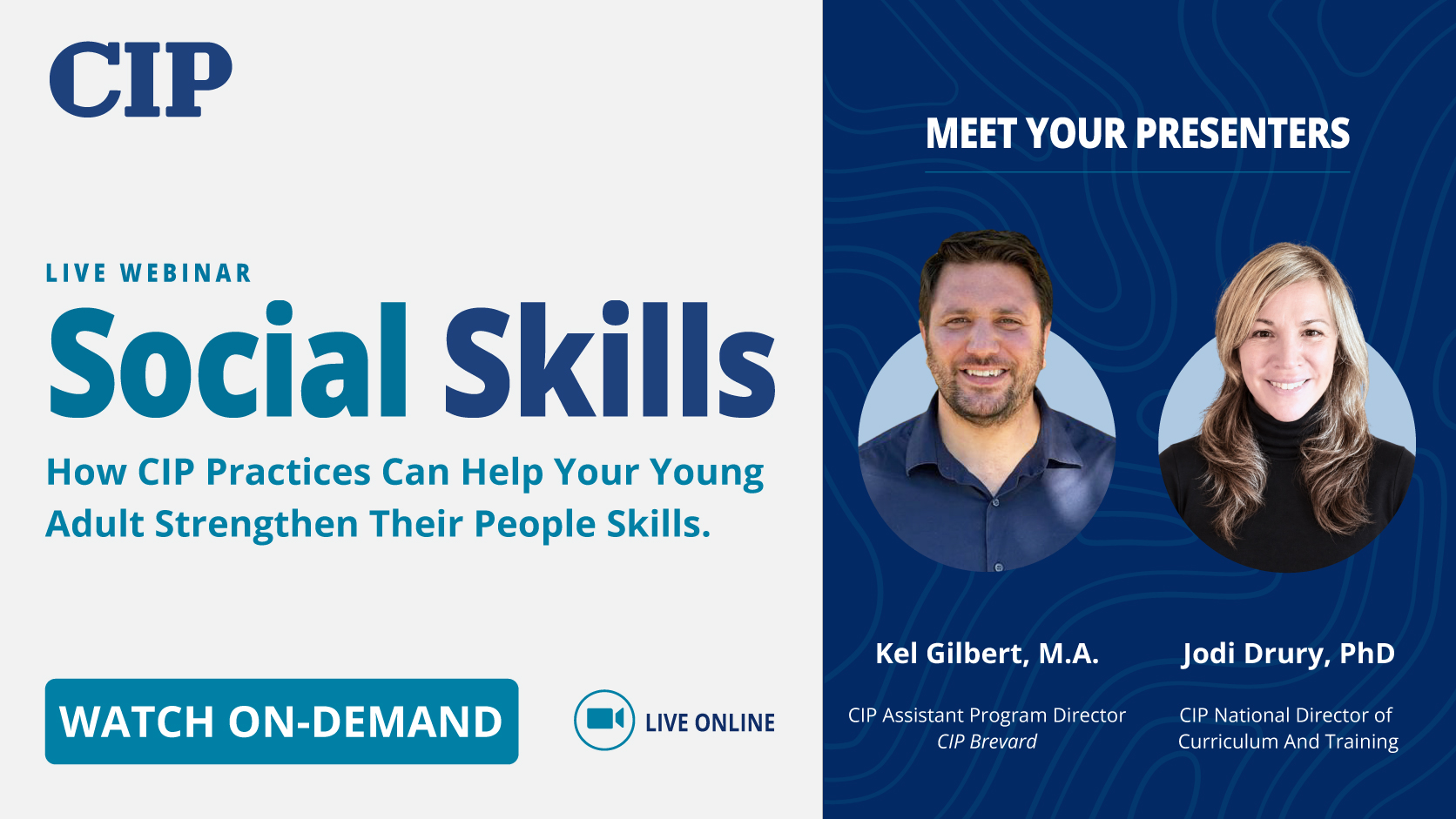
Live Presentation Recorded on Thursday October 22nd
Watch On-Demand!
Hosted by CIP Brevard Assistant Program Director Kellen Gilbert and CIP Director of Curriculum & Training, Dr. Jodi Drury
Strong social skills play an important role in helping young adults build meaningful relationships, succeed in college and careers, and become more independent. For neurodivergent young adults, navigating social situations can involve additional challenges, from interpreting nonverbal cues and managing social anxiety to understanding unspoken expectations and advocating for their needs.
In this webinar, CIP’s Kellen Gilbert and Dr. Jodi Drury explore how CIP helps young adults identify, practice, and strengthen the social skills they need to thrive in everyday life.
Through individualized coaching, small-group instruction, role-playing, and supervised community experiences, CIP provides opportunities for students to learn social concepts, practice conversations, receive constructive feedback, and apply their skills in real-world settings. Drawing on the evidence-based PEERS® curriculum, staff help students develop skills such as initiating and maintaining conversations, recognizing facial expressions and body language, navigating relationships, and communicating effectively in academic, professional, and social environments.
The webinar also introduces practical strategies families can use at home. These include HALT, which helps individuals identify whether hunger, anger, loneliness, or tiredness may be affecting their behavior, and SODA, a step-by-step approach to pausing, observing a situation, deciding how to respond, and acting on a plan. The presenters discuss additional approaches to emotional regulation, including mindfulness, breathing exercises, music, and physical activity, while emphasizing the importance of understanding each young adult’s individual needs.
Other topics include balancing screen time with in-person social engagement, building intrinsic motivation, strengthening self-advocacy, and helping young adults develop friendships around their interests and strengths. Through person-centered planning, students identify their own goals and take an active role in working toward them. Examples from CIP illustrate how these skills develop through everyday experiences, from approaching a local business to explore volunteer or job opportunities to organizing social activities with peers independently.
Throughout the discussion, Kel and Jodi emphasize that social growth takes time, practice, and trust. Rather than forcing social participation or expecting every student to follow the same path, CIP works alongside each young adult to build confidence, recognize individual needs, and develop the skills to navigate relationships and community life more independently.
Families will leave with practical ideas for supporting social development at home and a better understanding of how consistent practice, meaningful connections, and individualized support can help young adults build lasting relationships and prepare for life beyond CIP.