
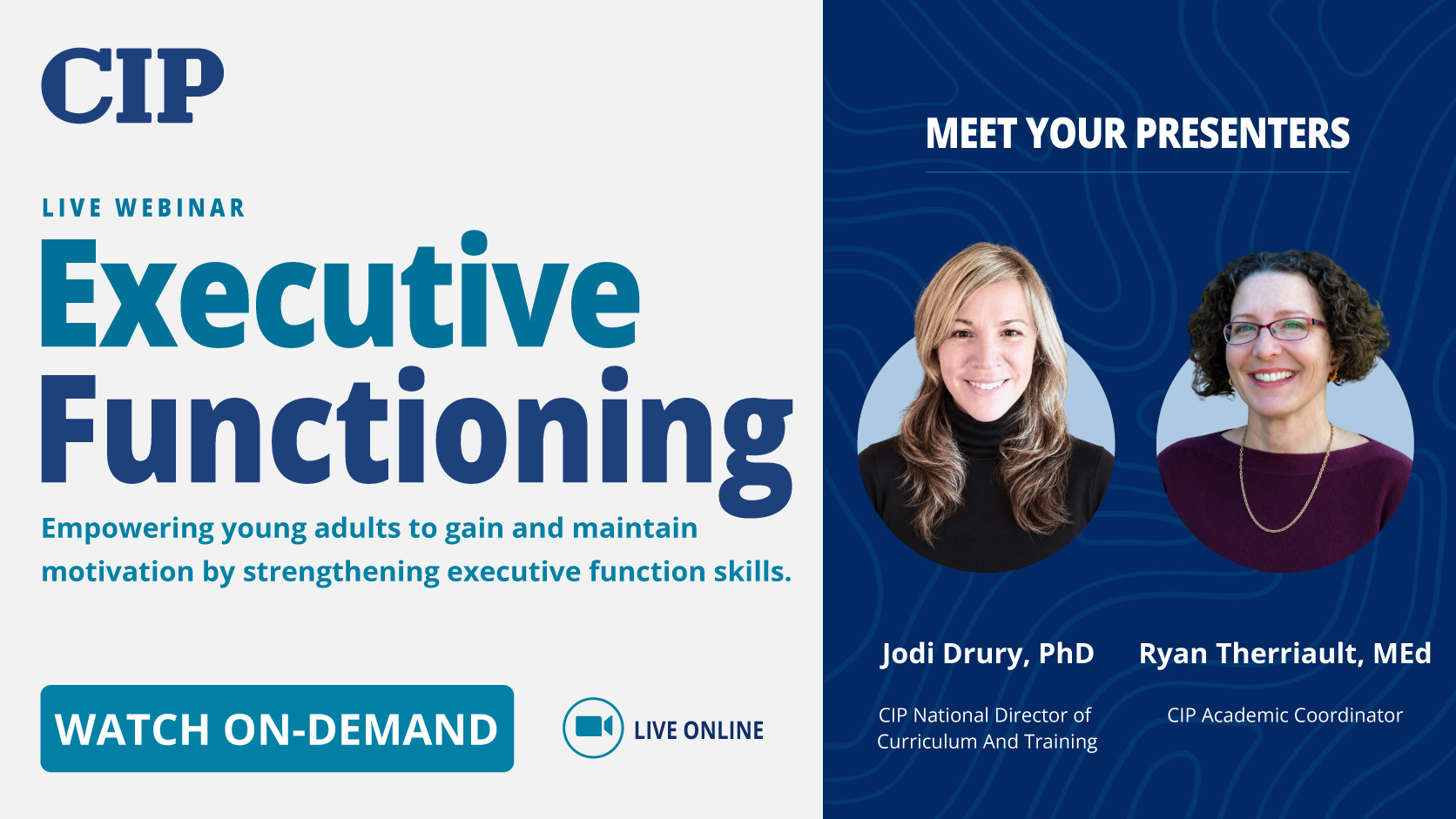
Live Presentation Recorded on Thursday September 24th
6pm EST
Watch On-Demand!
Hosted by CIP Director of Curriculum & Training, Dr. Jodi Drury and CIP Lead Academic Coordinator, Ryan Therriault
How do executive function skills influence motivation and what can families, educators, and professionals do to help neurodivergent young adults build both?
Watch for an engaging webinar exploring the connection between executive functioning and motivation. Through direct instruction, real-world case studies, and conversational discussion, Jodi and Ryan discuss practical strategies for understanding and addressing executive function challenges for adolescents and young adults with autism, ADHD, and other learning differences.
The webinar begins with Pre-Executive Function (Pre-EF) best practices, including how basic needs, goal setting, real-life social and life skills experiences, and an individual’s growth continuum can serve as a foundation for motivation.
Presenters then explore executive function skills and discuss practical coaching-based approaches for helping young adults work through challenges and develop greater independence.
For over 40 years, CIP has supported young adults ages 18 to 26 with autism, ADHD, and other learning differences across five comprehensive transition centers nationwide. As Drury notes in the webinar, research and experience indicate that at least 70% of neurodiverse young adults struggle to navigate executive functioning in their daily lives.
1. Meeting Basic Needs and Removing Initial Barriers
Before asking young adults to engage in complex executive functions, their fundamental physiological and emotional needs must be met. Theriot highlighted that when basic needs, such as proper nutrition, hydration, and sufficient sleep are neglected, individuals enter a reactive “lizard brain” state rather than accessing the cortex needed for clear, complex thinking.
Common initial barriers that hinder task initiation include:
- Fear of Failure (or Success): History of negative experiences often creates anxiety around making mistakes. Framing failure as an essential part of the learning process is crucial.
- Lack of Experience or Practice: Young adults may not have had sufficient exposure to or practice with basic everyday tasks (such as sweeping a floor or using a vacuum hose properly).
- Perceived Task Difficulty: Overwhelming visual or conceptual scale often paralyzes action.
- Sensory Overload & Language Barriers: Unaddressed sensory aversions (e.g. loud noises) or unclear instructions create immediate friction.
2. Understanding the Executive Functioning Clusters & Practical Solutions
Drawing from Dr. Brown’s model of executive functioning and framework concepts from Landmark College, Theriot outlined key executive skill clusters, common pitfalls, and practical strategies:
| Executive Function Skill | Common Challenges / Pitfalls | Practical Strategies & Solutions |
| Activation (Organizing, prioritizing, initiating) | Procrastination, delay, difficulty deciding what to do first. | Pair tasks with pleasant activities (e.g. dance parties while sweeping), build confidence through step-by-step guidance. |
| Focus (Sustaining and shifting attention) | Getting stuck on hyper-detailed minutiae (e.g. fixating on slide bullet counts). | Set temporary limits, isolate single tasks, use timed focus blocks with breaks. |
| Effort (Regulating alertness and processing speed) | Lethargy, slow movement, sleep issues, difficulty sustaining stamina. | Set target completion times, incorporate frequent breaks, offerHard-to-Easy or Easy-to-Hard task order choices. |
| Emotion (Managing frustration and regulating mood) | Rapid catastrophic thinking (“I’m cooked”), difficulty letting go of errors. | Journaling thoughts, physical energy releases (e.g. throwing a medicine ball), conducting “worst-case scenario” reality checks. |
| Memory (Utilizing short-term/working memory) | Forgetting items, missing appointments, difficulty retrieving past info. | Offload information using digital planners/calendars, post-it notes, color-coding, concept mapping, and voice-to-text tools. |
| Action (Self-monitoring and pacing) | Impulsively taking on too many commitments; struggling with boundaries. | Maintain clear prioritized task lists, script self-advocacy language (learning to say “no”), and utilize time-boxing (e.g. Pomodoro technique). |
3. Top-Down Goal Setting: “House, Mouse, Spouse”
To foster genuine intrinsic motivation, young adults must connect immediate tasks to their personal long-term vision. Theriot described a top-down goal-setting process that begins by asking the student what they want their life to look like in 10 years (often summarized lightheartedly as the “house, mouse, spouse” framework).
By connecting their personal aspirations, such as independent living, career goals, or hobbies—back to the practical daily habits required to afford and sustain that lifestyle, young adults see the clear purpose behind learning life skills, social skills, and academic habits.
4. Execution Frameworks: The “Get Ready, Do, Done” Method
For task execution, CIP advocates for strategies such as Sarah Ward and Kristin Jacobson’s Get Ready, Do, Done framework:
- DONE (Visualize First): Start by visualizing or finding a picture/example of what the completed task looks like in its ideal state.
- GET READY (Gather Tools): Identify and gather all necessary tools, ingredients, and materials before beginning.
- DO (Execute): Step through the actual action items required to reach completion.
Planning for Contingencies & Self-Reflection
A critical part of task preparation involves discussing: “What if the plan doesn’t work?” Identifying a backup “Plan B” reduces panic when errors occur. Following task execution, supporters should conduct a supportive, non-judgmental motivational interview asking:
- Did we follow our plan?
- What went well today?
- What can we try differently next time?
5. Key Audience Q&A Highlights
- College Accommodation for Reading Paralysis: When students stare at unappealing reading assignments for hours without starting, traditional college accommodations may be limited. Solutions include utilizing speech-to-text or screen-reading software (e.g. Speechify), working with private tutors trained in assistive technology, and breaking down reading assignments into small, permission-granted goals (e.g. “find just two main takeaways”).
- Rejection-Sensitive Teens: Reframing negative self-talk should occur outside emotional crisis moments. Proactively practicing a “growth mindset” and rehearsing positive reframing (e.g. changing “I failed” to “This is a growth opportunity”) creates a mental routine that can be accessed during moments of frustration.
- Distinguishing Can’t vs. Won’t: Refusal often stems from an underlying fear of failure rather than defiance. Utilizing positive external reward systems, offering structured choices (e.g. choosing between a digital planner or a to-do list), and co-engaging in tasks (“I’ll do half, you do half”) helps lower initiation barriers.
- Understanding Motivation vs. Determination: Motivation rarely precedes action; rather, starting a task, even while feeling uncomfortable, is what builds momentum and motivation. Learning to tolerate temporary discomfort is fundamental to executive growth.
Key Takeaways
- Learn to identify Pre-EF strategies and key executive function skills
- Develop a greater awareness of executive function strengths and challenges
- Explore the relationship between executive functioning and motivation
- Learn specific strategies to increase and sustain motivation
- Apply strategies to real-life social, independent living, and life skills scenarios