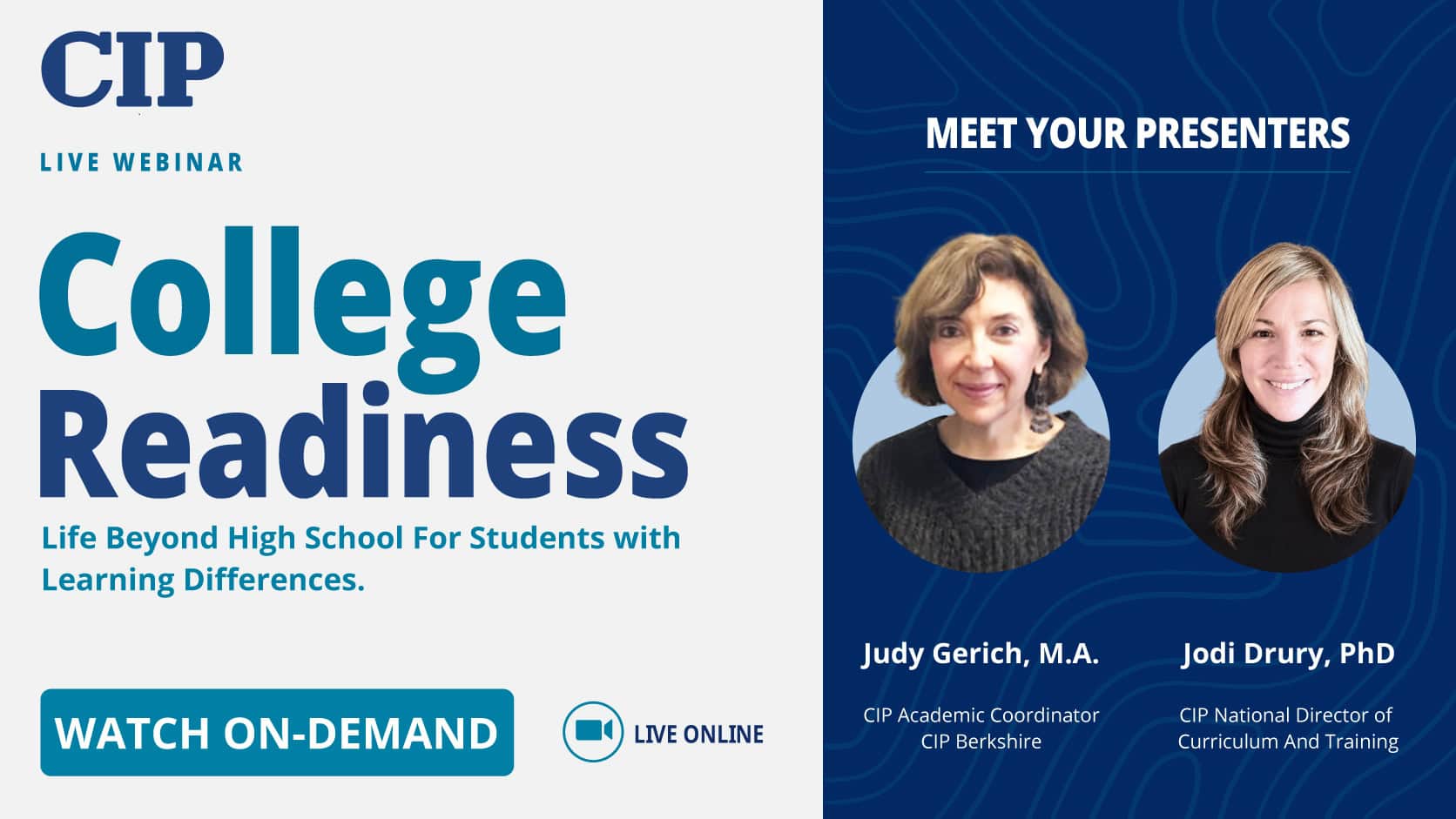
Choosing a college or university is an important milestone for any young adult, but for students with autism, ADHD, and other learning differences, finding the right post-secondary environment involves more than academics. Understanding individual strengths, developing independent living skills, identifying the right level of support, and finding an environment where students feel comfortable and confident are all essential parts of preparing for life after high school.
In this CIP webinar, Jodi Drury, National Director of Curriculum & Training at the College Internship Program (CIP), welcomes Judy Gerich, an experienced post-secondary educator and CIP team member, for a conversation about college readiness, navigating college options, and helping neurodiverse young adults find the right path forward.
Webinar Details
- Recording Date: Thursday, November 12, 2026
- Time: 6:00–7:00 PM ET / 5:00–6:00 PM CT / 3:00–4:00 PM PT
- Where: On-demand
- Cost: Free
In this webinar recap, you’ll learn:
- Why being smart doesn’t automatically mean being ready for college
- How to find the right college fit, with a campus visit checklist
- The four levels of college support for students with autism, ADHD, and learning differences
- When a community college may be the better starting point
- How to prepare students to advocate for themselves, and what to do if college doesn’t go as planned
- A curated list of books and college planning resources
About This Webinar
Why College Readiness Matters
College brings a new level of independence. Students manage their own schedules, keep track of assignments across several classes, ask professors for help, and request accommodations themselves, often without the daily structure high school provided. For students with learning differences, these executive functioning demands can be as challenging as the coursework itself.
Preparing for that shift ahead of time, and choosing a program with the right level of support, can help students start college ready to succeed.
Who Should Watch This Webinar
- Parents and guardians exploring the next step for a high school student or young adult with autism, ADHD, or another learning difference
- Students considering college or postsecondary programs
- Educators, school counselors, independent educational consultants, and transition specialists
Meet Your Presenters
Judy Gerich, M.A.
Academic Coordinator, CIP Berkshire
Judy has been the Academic Coordinator at CIP Berkshire since 2016. She joined CIP in 2012, first as a Career Coordinator and then as an Admissions Coordinator. She holds a teaching certificate in social studies education and degrees from the University at Buffalo. Judy has taught at the middle school, high school, and college levels, and has tutored many students on the autism spectrum and with learning differences. She has presented at regional and national conferences, including NYSACAC, HECA, and PACAC.
Jodi Drury, PhD
National Director of Curriculum & Training, CIP
Jodi spent more than 20 years in special education before joining CIP, as a K–12 teacher and administrator and as an adjunct professor at colleges and universities in Massachusetts. Her doctoral research focused on Multi-Tiered Systems of Support, and she has published articles with NASET and AASEP. At CIP, she creates the curriculum and training materials that help staff and students thrive.
Webinar Highlights: Preparing for College and Beyond
Neurodiverse Students and College: By the Numbers
Jodi opened the webinar with a look at the latest numbers on neurodiverse young adults and higher education:
34–36%
of neurodiverse young adults enroll in postsecondary education
About half
the enrollment rate of their neurotypical peers
Most
choose community colleges or other two-year institutions
Rising
the number of neurodiverse students going to college is rapidly increasing
As Judy noted, there are more college support options today than ever before, but enrolling is only the first step. Many neurodiverse students never use the accommodations they are legally entitled to, and some quietly drop out instead of asking for help.
College Readiness Is About More Than Academic Ability
One of the central themes of the discussion is that being academically capable does not necessarily mean being ready for the college experience.
“Smart does not equal readiness.”
— Judy Gerich, M.A., Academic Coordinator, CIP Berkshire
As Judy explains, students can be highly intelligent and academically successful while still needing support with executive functioning, time management, organization, social skills, problem-solving, and self-advocacy.
College introduces a different level of independence. Students are responsible for initiating and completing assignments, communicating with professors, managing schedules, accessing accommodations, navigating campus environments, and balancing academic responsibilities with their personal well-being.
Readiness skills Judy looks for
- Initiating schoolwork without being reminded
- Completing and submitting work, and confirming it was received
- Time management and backward planning for exams and long assignments
- Problem-solving, from getting textbooks to arranging rides and extra test time
- Self-advocacy, including using accommodations and reaching out to professors
- Resilience, so a setback leads to re-engaging instead of pulling away
Judy also pointed out that many of today’s college-age students were in middle or high school during the COVID-19 pandemic, when there were fewer chances to practice these skills in person.
These skills are not always developed simply by being told what to do. They require opportunities to practice, make mistakes, receive feedback, and gradually build confidence and independence.
The ability to recognize when help is needed and take the steps to seek it can be just as important to college success as academic preparation. From her own years teaching college classes, Jodi has seen that the students who reach out, even just to say “I don’t know what’s going on, can you help me?”, are the ones who succeed.
Understanding Individual Needs and Developing Independence
Preparing for college should be an ongoing process that involves both students and families. An important part of that process is gradually shifting responsibility toward the student, allowing them to become more actively involved in decisions about their education and future.
Families can help by exploring students’ interests, identifying potential career paths, and considering different educational environments. This might mean exploring a four-year university, a community college, a specialized college, or a college with a comprehensive support program.
It is equally important to recognize that interests and career goals can change. Students do not necessarily need to have their entire future mapped out before taking their next step. Exploring different subjects, gaining experience, and discovering new interests can help students find a direction that is meaningful to them.
Judy shared the story of a CIP student who started out working toward a business degree, but whose heart wasn’t in it. After a conversation with a tutor sparked a new interest, the student switched to an 18-month respiratory care therapy program at the local community college, completed it, and passed the board exams. Choosing a path still matters, even if Plan A changes along the way.
The goal is to help students develop the self-awareness and confidence to make informed decisions about their futures.
Finding the Right College: Fit Matters
A college that looks good on paper isn’t necessarily the right college for every student.
Judy emphasizes the importance of visiting campuses, touring different types of institutions, and speaking directly with the people responsible for student support services. Families should consider more than academic programs and admissions requirements. They should also pay attention to campus culture, accessibility, class sizes, available resources, and how students are treated during the admissions process.
A welcoming environment can make a meaningful difference, particularly for students who may have experienced challenges in previous educational settings.
Families should also consider whether the college environment is a good fit socially, culturally, and personally. Does the student feel comfortable there? Can they envision themselves living and learning on campus? Are the people and resources available to help them succeed?
Judy recommends taking notes and photos during campus visits, documenting conversations, and keeping track of important details. Visiting multiple schools can help families make meaningful comparisons rather than relying solely on a college’s website or reputation.
Campus Visit Checklist
- Take notes and photos so schools don’t blend together
- Write down who you met, what they said, and their contact information
- Note the size of the student body and any special support programs
- Meet with the Disability Resource Center and ask about staffing and caseloads
- Bring another family member along as a second set of eyes
- Notice how welcoming people are, to the student’s learning style and to who they are as a whole person
- Talk it over afterward: How were you treated? How did you feel? Can you see yourself living and learning here?
Understanding the Different Levels of College Support
One of the most valuable parts of the webinar is the discussion about the different levels of support available to students with autism, ADHD, and learning differences.
Not all colleges offer the same resources, and families should understand what is available before making an enrollment decision.
| Level of Support | What It Offers | Good to Know |
|---|---|---|
| 1. Disability Resource Centers | Accommodations required by the ADA, plus campus services like tutoring, writing centers, and math centers | Staffing and access vary widely. Students must request and use accommodations themselves. |
| 2. Comprehensive college-based programs | Structured help with executive functioning, academic organization, and social skills | Separate application, often an interview, and additional fees |
| 3. Specialized colleges | A whole campus designed around students with learning differences | Fewer majors to choose from, but support is built into the overall experience |
| 4. Transition programs like CIP | Individualized support in academics, careers, social skills, and independent living | Students take college courses and internships while building real-world independence |
1. Disability Resource Centers and Traditional College Support Services
Colleges and universities provide disability support services and accommodations for eligible students. However, the level of staffing, accessibility, and additional resources can vary considerably.
Families should look beyond whether a college has a Disability Resource Center (DRC). Consider whether students can access tutoring, writing and math centers, academic advising, and regular appointments with support staff. Ask about staff availability, appointment scheduling, and whether students receive ongoing assistance or are primarily responsible for navigating services independently.
Judy also suggests asking about caseloads (a staff member with 50 students may not be easy to see) and whether services are available outside of 9-to-5 hours. One nearby community college, for example, now offers virtual sessions on Sundays.
An important consideration is that students must learn to access and advocate for the accommodations available to them. Having accommodations in place does not automatically mean a student will use them.
2. Comprehensive College-Based Support Programs
Some colleges offer specialized programs in addition to their traditional disability services. These programs may provide more structured assistance with executive functioning, academic organization, social skills, and navigating the college experience.
These programs typically require a separate application and may involve additional fees beyond regular tuition. Judy estimated that these fees can run roughly $7,500 to $15,000, depending on the program.
Examples discussed during the webinar include:
- Bridge to Adelphi at Adelphi University (Long Island, NY). A former CIP Berkshire student recently earned a bachelor’s degree there.
- Lynn University (Florida). Offers supports for students with ADHD and autism, plus a strong theater program.
- Saint Joseph’s University (Philadelphia)
- Drexel University (Philadelphia). Has a well-regarded program for students on the autism spectrum.
- George Mason University (Northern Virginia). A former CIP student chose George Mason’s program.
- Excel at Bridgewater State University (Massachusetts). A recent CIP student’s family reports it has been a good fit.
- SALT at the University of Arizona. Judy described it as a robust program that also includes social skills support.
These programs offer varying levels and types of support, making it important for families to understand what is included and how services align with their student’s needs. To find them, Judy recommends starting with an online search for “postsecondary support programs at colleges,” then narrowing by geography. Some families hire a tutor or educational consultant to build a list, and it’s wise to set aside time for the separate applications and interviews.
3. Specialized Colleges for Students with Learning Differences
Some institutions are specifically designed to serve students with learning differences and offer a more comprehensive support environment.
Judy highlights Beacon College and Landmark College as examples of specialized colleges with structured academic support and a campus environment designed around their students’ needs.
These institutions typically offer a more limited selection of majors than larger universities, but their overall approach to student support may be a better fit for individuals who benefit from a more structured educational experience.
4. Transition and Support Programs Like CIP
College Internship Program offers another pathway for young adults who may benefit from additional preparation and support as they work toward greater independence.
Unlike a traditional college or university, CIP is a comprehensive transition program for neurodiverse young adults ages 18–26. Students receive individualized support in areas such as academics, career development, social skills, and independent living.
Through opportunities to take college courses, participate in internships, develop practical life skills, and build meaningful relationships, students gain experience navigating real-world responsibilities while receiving guidance along the way.
The emphasis is on developing self-knowledge, independence, and the skills needed to pursue meaningful academic, career, and personal goals.
Community College vs. Four-Year University: Which Is the Better Fit?
Community colleges can be an excellent starting point for students who benefit from a smaller, more accessible learning environment.
Judy notes that community colleges often provide greater opportunities for students to connect with faculty and staff, navigate a more manageable campus, and explore different academic interests. They can also offer significant financial advantages, with lower tuition costs and opportunities to transfer to a four-year institution later.
| Factor | Community College | Four-Year University |
|---|---|---|
| Size | Smaller student body; easier to learn where everything is | Can be large and spread across multiple campuses |
| Access to people | Generally greater access to faculty and staff | Varies; support may be harder to find at a large school |
| Cost | Lower tuition, and many are free | Typically higher tuition and fees |
| Flexibility | Room to explore interests; a stepping stone to transfer | Wider choice of majors and campus life |
Judy has seen students come to CIP after feeling overwhelmed at very large universities. At a community college, she explained, students are more likely to know where things are, and faculty and staff are often used to serving many different kinds of learners, from adults changing careers to high school students taking early classes. Many community colleges are also free.
For some students, beginning at a community college provides an opportunity to build confidence, strengthen academic skills, and gradually develop greater independence before transitioning to a larger university.
However, there is no single educational path that works for everyone. The decision should be based on the student’s interests, support needs, learning preferences, and readiness for different levels of independence.
Preparing Students to Advocate for Themselves
Self-advocacy is one of the most important skills students need to develop before entering college.
Unlike high school, where parents and school personnel often play a significant role in coordinating educational support, college students are generally responsible for communicating their needs and accessing available resources.
Students should understand their learning differences, become familiar with their accommodations, and learn how to communicate with professors, academic advisors, and Disability Resource Center staff.
Jodi and Judy also emphasize the importance of preparing documentation before transitioning to college. Students and families should work with the college’s disability services office to understand current documentation requirements and determine what information is needed to establish appropriate accommodations.
Jodi added that IEPs end at high school graduation, so families should keep evaluations current (many colleges look for testing from the last year or two). She also recommends reading through the IEP with the student before graduation, since many students don’t know what accommodations they have or that they are entitled to request them.
Importantly, having accommodations available does not guarantee that students will use them. Some may feel uncomfortable asking for assistance or may not fully understand how to access the resources available to them. Developing the confidence to seek help, communicate challenges, and build relationships with support personnel can make a significant difference.
Some college accommodations may also be new to students. For example, a professor may allow a student to step out of class when they feel dysregulated and return when they’re ready, something that may not have been accepted in high school.
Tips for college or program interviews
- Practice ahead of time with a trusted person who asks sample questions
- Bring a few bullet points of questions or things to mention, on paper or a phone
- Keep a small, discreet fidget on hand if it helps
- Ask whether a phone or Zoom interview is an option if that would help the student shine
What Happens When College Doesn’t Go as Planned?
Not every student has a successful first college experience, and that doesn’t mean college or higher education is no longer an option.
Judy shares examples of students who struggled academically, socially, or emotionally after transitioning to college. In some cases, students became overwhelmed, withdrew from their classes, or concealed their difficulties from their families.
In one case, a family arrived to pick up their son for Thanksgiving and learned he had barely left his dorm room in two weeks after failing some tests. In another, a student who felt like a failure kept driving to campus parking lots for months without attending class. Because parents don’t automatically have access to college grades, these struggles can stay hidden. Jodi asked her own daughter to sign a release so she could stay informed, a step many families discuss before the semester starts.
These experiences highlight the importance of recognizing when something isn’t working and understanding why.
Rather than simply encouraging students to try harder or return to the same environment, families should take time to understand the underlying challenges. Is the student struggling with executive functioning? Are they having difficulty initiating assignments, managing their time, navigating social situations, or accessing accommodations? Is the environment itself a poor fit?
Judy added that sleep, phone use, and gaming can also play a role. And if a student needs to drop a class, a withdrawal (W) is far better than a failing grade on a transcript.
For students who have experienced setbacks, rebuilding confidence is an important first step. Exploring areas of personal interest, taking a smaller class, working with a tutor, or receiving additional guidance can help create opportunities for success.
Judy also suggested wellness activities, working with a therapist, or joining an exploratory group. For students with mental health diagnoses, she recommends meeting with the college’s Disability Resource Center in person before classes start, sharing warning signs together with the student, and making sure the student knows which campus and community supports to call in a crisis.
As Jodi points out, mistakes and setbacks are part of the learning process. They can provide valuable insight into what students need, where they excel, and what skills they still need to develop.
The important thing is to recognize that one challenging experience does not define a student’s potential or future.
The Role of CIP in Preparing Young Adults for What’s Next
Throughout the webinar, the conversation reinforces an important distinction between academic preparation and preparing for adulthood.
At College Internship Program, students work toward developing the skills and confidence needed to navigate college, careers, relationships, and independent living.
CIP’s individualized approach combines academic opportunities with practical experiences in career development, executive functioning, social skills, and life skills. Students have opportunities to explore interests, participate in internships, take college courses, and practice managing everyday responsibilities.
The goal isn’t simply to help students get into college. It’s to help them develop the tools to succeed in whatever educational, career, and personal direction they choose.
Finding the right next step is about understanding the individual, recognizing their strengths and support needs, and creating an environment where they can continue to grow.
Whether that means attending a four-year university, starting at a community college, enrolling in a specialized college, or participating in a comprehensive transition program, there are multiple pathways to a fulfilling and independent adult life.
How CIP Supports Students in College
Students in CIP’s Academic Track enroll at a local college or take online courses with CIP’s support. Most begin with one or two classes and build from there. Alongside their coursework, they work with CIP staff through executive functioning and content-based modules and meet weekly with an advisor, so they have structure and guidance as they become more independent.
At CIP Berkshire, Judy helps every incoming student prepare for their first accommodations meeting at the local community college. They review the student’s file together, talk through which accommodations helped in high school and which might help now, and Judy attends the meeting for support. She also spends two days a week on campus, where she can step in when a student needs help, and works with professors when classroom expectations need to be practiced.
Learn more about CIP’s College Support and Executive Functioning curriculum.
Key Takeaways and Recommended Resources
Key Takeaways: College Readiness for Students with Learning Differences
Academic ability does not automatically equal college readiness. Executive functioning, time management, organization, social skills, problem-solving, and self-advocacy are equally important.
Self-advocacy is essential to college success. Students must learn to communicate with professors, access accommodations, ask questions, and seek help when challenges arise.
Understand the different levels of college support. Disability Resource Centers, comprehensive college-based support programs, specialized colleges, and transition programs offer different levels of assistance.
Finding the right college fit matters more than choosing a school’s reputation. Consider campus size, environment, academic interests, social opportunities, accessibility, and available support services.
Explore community colleges as a valuable pathway. Two-year institutions can provide a more manageable starting point, lower costs, and opportunities to transfer to a four-year college.
Start preparing for college before high school graduation. Encourage students to understand their learning differences, practice independence, explore interests, and gradually take ownership of decisions.
Research disability services beyond what is listed on a college website. Ask about staffing, appointment availability, tutoring, academic assistance, and how students access accommodations.
Visit campuses and ask questions. Meet with disability support staff, speak with academic departments, observe the environment, and consider how the student feels during the visit.
College is not a one-size-fits-all experience. Students may benefit from different educational pathways, levels of structure, and opportunities to explore their interests.
A challenging college experience doesn’t mean the journey is over. Rebuilding confidence, identifying barriers, and finding a better environment can help students move forward.
Independence develops through practice. Students need opportunities to make decisions, work through challenges, learn from mistakes, and gradually take greater responsibility.
Success after high school looks different for everyone. College, careers, relationships, and independent living can take many different forms. The goal is to find a meaningful path that aligns with each student’s abilities, interests, and aspirations.
Recommended Books and College Planning Resources
The following books and resources were discussed or recommended during the webinar to help students, parents, and families explore college options, understand learning differences, and prepare for the transition to adulthood.
From CIP’s Founder
Autism and Learning Differences: An Active Learning Teaching Toolkit
Michael McManmon, foreword by Stephen Shore
A hands-on toolkit from CIP’s founder. Students and staff at all five CIP centers contributed to it.
Michael McManmon, foreword by Stephen Shore
A guide for parents on helping an adolescent with autism or a learning difference become an independent adult.
College Search & Planning Guides
Judy’s tip: spend an afternoon at a bookstore paging through college resource guides before deciding which ones to buy.
Barron’s Profiles of American Colleges
College Division of Barron’s Educational Services
Judy’s favorite general tool: colleges are broken down by area of interest and cross-referenced by geography.
College Board
A planning resource for organizing college applications, requirements, and deadlines, with space to take notes as you tour.
The K&W Guide to Colleges for Students with Learning Differences
The Princeton Review
Profiles of colleges and the support programs they offer for students with learning differences.
Transition, Social Skills & Life Skills
Life After High School: A Guide for Students with Disabilities and Their Families
Susan Yellin and Christina Cacioppo Bertsch
A practical guide to the transition from high school. One of the authors has been a guest speaker at a CIP center.
Elizabeth A. Laugeson
From the UCLA PEERS® program, which CIP uses in its social skills curriculum. Covers conversation, communication, and relationships.
Succeeding in College with Asperger Syndrome: A Student Guide
John Harpur, Maria Lawlor, and Michael Fitzgerald
A student-focused guide to the academic and social side of college life.
Transitional Skills for Post Secondary Success: Reflections for Students with Learning Disabilities
Edited by Teresa Allissa Citro, foreword by Rick Lavoie
A collection of reflections on preparing for life after high school.
More Books Jodi Recommended During the Webinar
Haley Moss
Written by an autistic author about her own first year of college.
Developing College Skills in Students with Autism and Asperger’s Syndrome
Sarita Freedman
Strategies for building the skills students need before they start college.
How to College: What to Know Before You Go (and When You’re There)
Andrea Malkin Brenner and Lara Hope Schwartz
A general guide to the expectations and routines of college life.
Taking Flight: The Guide to College for Diverse Learners and Non-Traditional Students
Perry LaRoque
A guide to finding and succeeding at college for students who learn differently.
Rachel Bedard and C.C. Mallory Griffith
Real stories from autistic students and their parents about the road to college.
Note: Some of these are older college reference editions. Verify publication dates and use current college websites when researching admissions, programs, and support services.
Frequently Asked Questions
Does an IEP carry over to college?
No. IEPs end when a student leaves high school. In college, students request accommodations through the disability resource office and provide documentation, and many offices ask for a recent evaluation. Contact each college’s disability services office to confirm what they require.
Can parents see their student’s college grades?
Not automatically. Colleges generally need the student’s written permission to share grades and other records with parents. Many families talk about this before the semester starts and ask the student to sign a release.
What size college works best for students with learning differences?
It depends on the student, but Judy has found that schools with about 2,000 students or fewer are often a sweet spot. Between 2,000 and 5,000 students the experience changes, and at larger schools a student can get lost without strong self-advocacy skills.
Explore More from CIP’s Webinar Series
This webinar is part of CIP’s 2026–2027 educational webinar series. Catch up on earlier sessions:
- Empowering Young Adults to Gain and Maintain Motivation by Strengthening Executive Function Skills
- Social Skills: How CIP Practices Help Young Adults Strengthen Their People Skills
Coming up next: Navigating the Holidays: Understanding the Neurodiverse Young Adult Experience, with Belle Vang Ruiz, mental health therapist at CIP Long Beach.
Exploring the Right Next Step After High School?
Since 1984, CIP has helped young adults with autism, ADHD, and learning differences build the skills for college, careers, and independent living. Connect with our admissions team to learn whether CIP is the right fit.